Houston:
Austin Cochrum Burned In Static IgnitedFlash Fire at the Pump
UPDATE
by
Jennifer L. Hazen, Editor
February 20, 2003
We first reported this fire in September 2002
 Austin
Cochrum was filling up his truck, on September 9, at a local gas station.
He and his friend Josh cook had just been to a baseball game. Austin
had started the gas in his truck. He went over the Josh's truck and
put his credit card in for Josh to get some gas. Josh had supplied
the tickets to the ball game and Austin was repaying him in gasoline.
Austin
Cochrum was filling up his truck, on September 9, at a local gas station.
He and his friend Josh cook had just been to a baseball game. Austin
had started the gas in his truck. He went over the Josh's truck and
put his credit card in for Josh to get some gas. Josh had supplied
the tickets to the ball game and Austin was repaying him in gasoline.
Mr. Cochrum was attempting to sit down on the open door step of Josh's
1972 Chevrolet 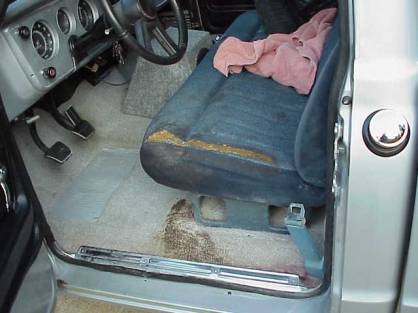 pickup
truck. He had his Nylon (or Polyester) wallet in his left hand. He
placed his left hand with the wallet on the fabric seat and was about
to touch the door frame to shift his weight and turn to sit when he
discharged to the door/fuel port area. The vapors coming from the
open fuel port ignited in a flash fire that caught his shirt on fire.
He ran into the station before he noticed he was burning. He received
second-degree burns to his left arm, left hand and side. The fire
burned through two shirts. Cochrum spent six days in a Houston burn
unit for treatment. He still is recovering after 5 months and it is
now believed he did receive some 3rd degree burns.
pickup
truck. He had his Nylon (or Polyester) wallet in his left hand. He
placed his left hand with the wallet on the fabric seat and was about
to touch the door frame to shift his weight and turn to sit when he
discharged to the door/fuel port area. The vapors coming from the
open fuel port ignited in a flash fire that caught his shirt on fire.
He ran into the station before he noticed he was burning. He received
second-degree burns to his left arm, left hand and side. The fire
burned through two shirts. Cochrum spent six days in a Houston burn
unit for treatment. He still is recovering after 5 months and it is
now believed he did receive some 3rd degree burns.
Austin was a scratch golf player before the fire (72 low score). Now
he is struggling to get his game back as he recovers form the fire.
Mr. Cochrum said:
"You see a lot of movies with explosions. I was just thinking
about getting out of there," Cochrum said. "
I didn't really have time to think about it. I just took off."
"I'll touch my truck before I fill up," Cochrum said. "I
will definitely be aware of it now. ... It will cause me to be in
less of a hurry." "I think I was more shocked
about being on fire more than anything," He stated that static
electricity would be on his mind while refueling his vehicle in the
future.
The Fire Marshall's office ruled the accident was the result of static
electricity, created by Cochrum, and reacting with gas vapors from
the vehicle's gas tank. They theorized the reaction came after Cochrum
rubbed his fabric wallet on his friend's fabric seat cover, which
made the static charge, then when he touched the outside of the truck
- BOOM!
We believe that when Austin reached across
the fabric seat, he had a static potential induced on his body from
the charged seat material. He discharged this (or equalized the potential)
when he touched the truck near the fuel port and the vapors. His burns
were consistent with a flash fire. The truck had its fuel port very
near the door. This model of truck had an open port design which allowed
large amount of vapor to escape during refueling. This contributed
to the intensity and volume of the flash fire Austin experienced.
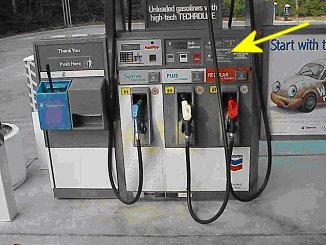 Josh
pulled the hose disconnect away from the pump to stop the flow. This
may have stopped the flow and reduced the amount of gasoline that
spilled out. However, we do not recommend this since the hose can
separate from the coupling resulting in a massive release of liquid
and cause a huge inferno. The best approach is to go into the station
and ask the attendant to hit the "All Stop" button or cut
off the pumps.
Josh
pulled the hose disconnect away from the pump to stop the flow. This
may have stopped the flow and reduced the amount of gasoline that
spilled out. However, we do not recommend this since the hose can
separate from the coupling resulting in a massive release of liquid
and cause a huge inferno. The best approach is to go into the station
and ask the attendant to hit the "All Stop" button or cut
off the pumps.
Josh pulled the
hose disconnect away from the pump to stop the flow. This may have
stopped the flow and reduced the amount of gasoline that spilled out.
However, we do not recommend this since the hose can separate from
the coupling resulting in a massive release of liquid and cause a
huge inferno. The best approach is to go into the station and ask
the attendant to hit the "All Stop" button or cut off the
pumps.
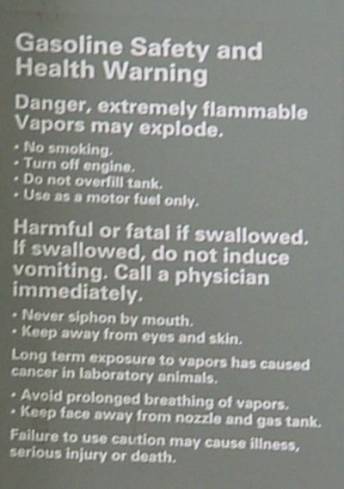
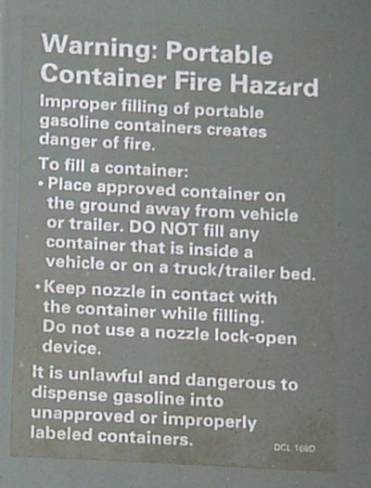
We visited a
Chevron station and found similar looking signs. One was on the hazards
of gasoline and one was on portable containers. In our view these
are not nearly enough to warn the public. They appear to be part of
the pump nomenclature not caution or warning signs. They also do not
state the needed facts about static, car re-entry or not removing
the nozzle as we have promoted in previous articles. They are shown
below.